Eric Kim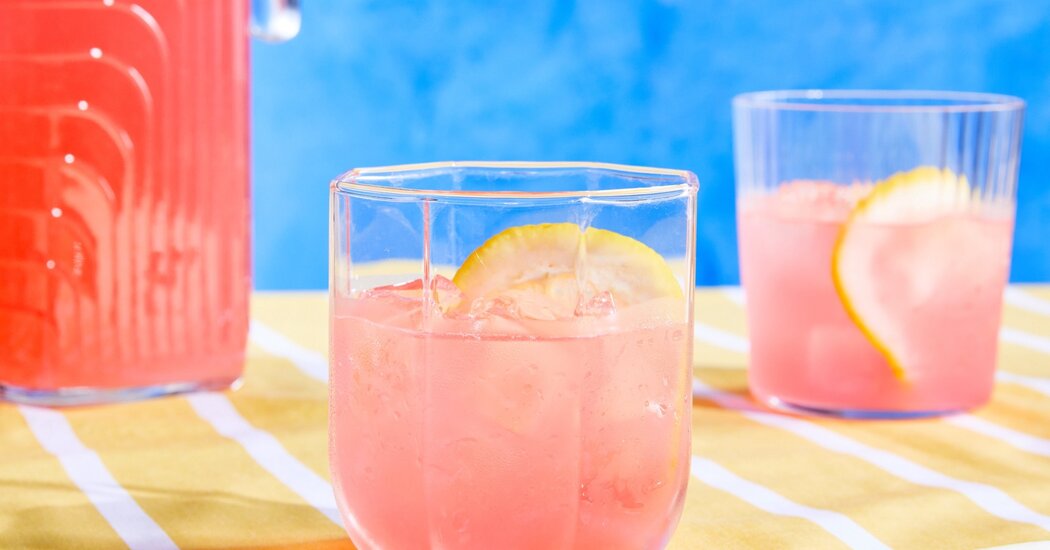
In his 1921 memoir, “The Ways of the Circus,” the lion tamer George Conklin tells of the time that his brother, Pete, following a traveling circus to sell lemonade, ran out of water for his concession stand.
With nary a spring or a well nearby, a desperate Pete sneaked into the dressing tent and stole a tub of rosy water, into which Fannie Jamieson, a bareback horse rider, had just wrung out her pink tights. Into his new, albeit dirty, supply, Pete stirred tartaric acid and lemon pieces, and he sold it as strawberry lemonade to great success. And so, in 1857, pink lemonade was born. Or was it?
A competing story credits Henry E. Allott with inventing pink lemonade: At 15, he ran away from home to sell concessions with another traveling circus. One day, according to Allott’s obituary in The New York Times, he accidentally dropped red cinnamon candies into his product but sold it anyway. Even then, it turned out, pink was a compelling marketing strategy.
If these rose-tinted tales feel spun to you, then you’re right on the money. “These are great stories, but I don’t think we should take them literally,” says Betsy Golden Kellem, a circus historian and a trustee of the Circus Historical Society.
“Cutting up jackpots,” she calls it, which in circus tradition means spinning and swapping war stories to build not just a sense of community but also a world of characters. The circus is a show, after all, and pink lemonade is one of its most vibrant props.
A child of the circus, both extraordinary and artificial.
Kellem, the author of the upcoming “Jumping Through Hoops” (Feminist Press, 2025), which focuses on women and gender performance in the 19th-century circus, considers pink lemonade “kind of a cultural shorthand” for the circus. Its whimsical cotton-candy color signals that you’ve stepped into the realm of the spectacle, a diffusion of the extraordinary and the artificial.
The thing is, pink lemonade rarely, if ever, included any actual lemon juice. Save for a handful of slices (reused from batch to batch as an illusion of freshness), lemons weren’t a big part of the original recipe. They were too expensive, Kellem says.
Instead, an acid was used, and for owners of circus concession stands, the acid of choice was tartaric. (These days, citric acid is more commonly used in fountain and bottled products, like Minute Maid and Tropicana, and in powdered mixes, like Country Time, Kool-Aid and Crystal Light. It’s why they taste the way they do.)
An 1807 ad in The Bath Journal marketed one of the first artificial lemonade mixes, “Albin’s Patent Sweet Acid,” which promised to impart “as rich a flavour as the finest and freshest Fruit.” No lemons required. All one had to do was stir a couple of tablespoons (“according to palate”) into a half-pint of water.
Unfortunately, lethal white powders could also be mistakenly sold for tartaric acid. In 1889, The Brooklyn Times Union published a warning to boycott lemonades “doctored with acid” after 50 people in Woodstock, Ontario, were reportedly poisoned at a picnic where lead-acetate-spiked lemonade was served.
There are many ways to dye lemonade pink without poisoning your guests. Many home brewers today splash some grape juice into their glasses, which brings both color and flavor. (Tartaric acid occurs naturally in grapes.) Cranberry juice works too, because what is pink but a deficiency of red? For a psychedelic hot pink, try a smidgen of beet juice, as the Southern food blogger Monique Kilgore (of Divas Can Cook) smartly suggests.
If it’s summer where you are, then the longest but most delicious way to pink lemonade is a juicy, ruby-rose syrup from your favorite seasonal fruits and berries: rhubarb for baby pink; raspberries for royal pink; strawberries for sunset pink; and cherries for vermilion pink.
You can stir the syrup into a pitcher of lemon juice and water, or you can pull from it as you would a sugar bowl for individual glasses of lemonade. This recipe yields a hydrating drink whose flavor comes mostly from the fruit, including many fresh lemons and their tart juice; just enough sugar to soften the citrus; and a pinch of salt, which lends brightness without heaviness, hydration without sickly sweetness.
If fresh-fruit syrup is outside your wheelhouse (or patience), then try stirring a little citric acid into a pitcher of regular lemonade, as my friend, the writer Allison Robicelli, does, knowing very well that it’s not just the color that makes lemonade pink.